Imagine your entire work is framed as a high-stakes RPG game.
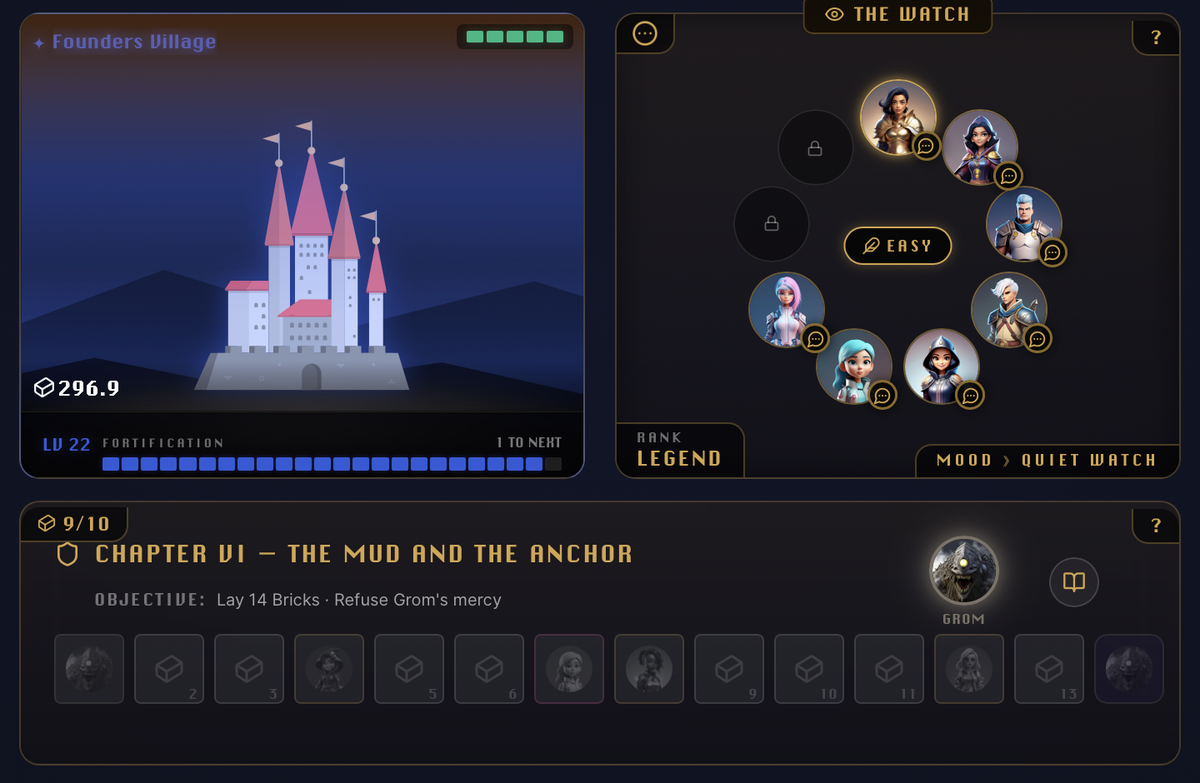
For the last 17 months, I've been building GoalWatch on nights and weekends. I'd like to find out whether it actually works, and I can't answer that on my own.
The idea
GoalWatch specialises in framing your entire work as a high-stakes RPG game.
Procrastination is an evil card that plays against you. Your quest is to progress despite it. You will collect a group of Watchers who stand by you to help you in the fight. Defeat the evil to level up your daily productivity. It's not a replacement for your work motivation; it's a complementary tool to boost satisfaction and results.
The ancient alliance is on your side, watching over your progress. They're legendary spirits summoned from the past, each a unique character with a different strategy for productivity and success. Just imagine RPG fantasy, but with a realm of legendary corporate IT experts.

Meet Elara, the Supreme Watcher. She guards the Wellspring of Momentum with unbroken discipline, inspiring everybody who interacts with her.

Or Nyx, who was an apex-level architect obsessed with optimisation. She built the Midnight Protocol to kill the 'incompetence ', so her legacy would survive when her time has come.
In GoalWatch, there are 42 other characters with interesting backstories. An LLM brings all of them to life to form the council for your real project. You progress in the game while you progress in your real work.
The Opposition

We have also 11 demons who will do everything to convince you to stop the work and procrastinate; for instance, listen to Vexil the MIND FLYER
“Candidly, Architect, nine months, just halfway to the MVP? The people who actually do this would have shipped, pivoted, and moved on by now. Between us: delete the project. You were never meant to finish it."
How does it work?
Just write what you did or plan to do each day; your story unfolds from your input, and characters play their roles each time you make progress.

Everything stays private unless you choose to join public alliances. Everyone participates in ranking, competing based on how consistently they update. The realm is full of artefacts, Crystals, Oil Vials or XP, which are boosters that can augment game rules or trigger special effects.

The journey motivates you to post updates and build a powerful game profile, and your citadel (goal/project representation) earns you status and recognition. All this in the name of becoming a smarter and more productive individual.
GoalWatch focuses on being accurate and aligned with character personality - never to be nice like generic AI

Each character is carefully crafted to avoid a generic message and to produce a sovereign response without needing to please anyone. Our work aims to strike a balance between a harsh character and insightful, wise comments.
Why are the game parts there

Characters react so you don't have to judge yourself. When I reread my own notes, I judge them: good day, wasted day. That judgment is where the guilt comes from, and guilt is what makes me stop writing. When a character reacts instead, I can look at my week with some distance. A few characters with opposing temperaments disagreeing about my Tuesday turned out to be more useful than any one voice.
The one who wants you to quit is deliberate

Everyone who has abandoned a side project knows the voice that says it isn't worth it. Here that voice is a named character, Lethos, whose line is "Quitting is mercy." Once the voice lives outside your head, it's easier to argue with. The other Watchers push back against it for you.
Stakes are why you come back. Your project has a momentum battery that drains every day you don't write. If it stays empty long enough, the project dies. That sounds harsh, but loss aversion is the mechanism doing the work. A streak you'd hate to lose gets you to open the app on a bad day.
Progress becomes visible

Every update adds to something that grows. The first milestone is 14 updates, which at a normal pace takes two to four weeks. Invisible work turns into something you can point at.
We aim to build a Realm platform for growth and insight

We want to connect everybody to share experiences and struggles in multiplayer. You can choose a private or public path, but your consistency stats always compete in the global ranking, showing you where you stand and how your effort earns prestige.
What the research does and doesn't say
The research on the writing part is reasonably solid. Teresa Amabile and Steven Kramer studied about 12,000 daily diary entries from knowledge workers. They found that making progress on meaningful work was the strongest daily motivator, including small progress (The Progress Principle, 2011). A 2016 meta-analysis in Psychological Bulletin (Harkin et al.) looked at 138 studies. It found that monitoring progress toward a goal improves the chance of reaching it, and that the effect is larger when progress is written down or reported to someone.
What nobody has shown is whether AI characters reacting to that writing adds anything on top. That's the open question, and it's why this is an experiment and not a launch.
The experiment
Work is slow, and resources are scarce. I have worked solo so far, without a budget or external help, to materialise my vision. The project is currently in beta. I really need to validate the idea. So far, everything is based on assumptions. My main objective is to prove that the tool really improves your performance. That's why I'm inviting the first users to try a program that can measure improvement.
- Who: programmers, professionals, side-project enthusiasts, learners, anyone. You choose one goal, such as "significant progress each day", or "finishing a side project" or "finalise a course".
- How long: 30 days, or until you reach 14 updates.
- What you commit to: one written update per working day. One sentence counts.
- What I measure:
- A two-minute survey before you start: how productive your last two weeks felt, and what you shipped.
- A one-minute check-in each week.
- The same survey at the end.
- How many people are still writing after one, two and four weeks.
- What I publish: the aggregate results on this blog, including if the answer is "it made no difference" or "most people quit in week one." No individual data, nothing identifying.
The measure is self-reported, and I know that's a weak one. I'm not claiming this is a controlled trial. I want an honest first signal before building further.
What it costs, and what happens to your writing
- Free while the invested token pool lasts: No card needed. Click the free option during sign-up. The pool size should last for the experiment length; I am allowing limited access for safety reasons.
- The AI runs on Anthropic models via AWS Bedrock. Your updates are not used to train models; that's in the terms of both providers.
- Please don't paste proprietary code or your employer's secrets. Write about what you did and how it went, not the code itself.
- Privacy policy
Tailored start based on your needs

You can choose one of 8 profiles based on your current situation. It helps Watchers address what's important to you.
Join
If you have a goal nobody sees the effort for, I'd like you in the first 30.
Join the experiment → · How GoalWatch works →
Bartosz Dąbrowski
The shadows are long, but the fire is bright.
[email protected]
-----------
It's one developer's project. You'll hit bugs. Bug reports and feedback earn in-app Crystals. Some Watcher replies will miss the mark, and I want to hear about those most.